UPDATES IN AML
The following summaries highlight key findings from research posters presented at the 66th ASH Annual Meeting, showcasing new developments in oral maintenance therapies for acute myeloid leukemia (AML).
In AML, relapses are common after remission. These treatments aim to help patients stay in remission longer while offering convenient, at-home options.
Oral Combination Therapy for AML: Decitabine/Cedazuridine (ASTX727) Plus Venetoclax(1)
What was this study about?
This phase 2 study tested a fully oral treatment option for people with newly diagnosed AML who cannot have intensive chemotherapy due to age or health conditions. The treatment combined a tablet form of decitabine/cedazuridine (ASTX727) with venetoclax, making it more convenient and needle-free.
Study overview
Who participated? 60 adults with newly diagnosed AML (average age 80). Most had high-risk AML due to genetic factors or prior health conditions.
What was studied? The effectiveness and safety of taking decitabine/ cedazurdine and venetoclax as a fully oral treatment.
Key results
Effectiveness:
• 67% of patients improved with treatment and had no visible signs of leukemia in their blood or bone marrow (complete remission)
• Among those tested, 51% had no detectable cancer cells using sensitive tests (MRD negativity)
• Patients lived for a median of 10.2 months, which increased to 12.7 months for those who had not received similar treatments before
Safety:
• Infections and gastrointestinal side effects were the most common overall side effects
• The most common serious side effects (grade 3/4) were:
o Fever with low white blood cells (neutropenic fever) – 10%
o Pneumonia – 8%
o Low white blood cell count (neutropenia) – 8%
• Infections of any type occurred in 27% of patients, and 3 patients (5%) died from bleeding or infections while in remission.
Key takeaway
This fully oral treatment offers an effective and convenient option for older or more frail patients with newly diagnosed AML, offering an alternative to injection-based treatments. Many patients showed improvements, including complete remission. Serious side effects like infections and low blood counts occurred, so preventative antibiotics and dose reductions should be used alongside this treatment. This approach is a promising option for patients who are not able to receive intensive chemotherapy.
Oral Maintenance Therapy for AML: Decitabine/Cedazuridine (ASTX727) Plus Targeted Agents(2)
What was this study about?
This study tested a personalized oral maintenance therapy for people with AML who are in remission but at risk of the disease coming back (relapse). The goal was to see if combining a pill form of decitabine/cedazuridine with other targeted oral agents could help maintain remission and prevent relapse.
Study overview
• Who participated? 31 adults with AML were in remission. 15 people had received intensive chemotherapy and 16 people had lower-intensity treatment. The average age of participants was 68 years old
• What was studied? The effectiveness and safety of decitabine/cedazuridine alone or combined with one of four targeted oral agents (venetoclax, gilteritinib, ivosidenib or enasidenib) as maintenance therapy
Key results
Effectiveness:
• Patients stayed in remission for a median of 22.4 months, with 59% still in remission after 1 year
• Survival rates were 82% across the whole group. Out of those patients who had previously received intensive chemotherapy, 88% were alive after 1 year
Safety:
• The most common side effects overall were:
o High blood sugar – 55%
o Increase in liver enzyme called ALP – 45%
o Low potassium – 45%
o Feeling sick – 45%
• Common serious side effects (grade 3 or higher) included:
o Low white blood cells (leukopenia) – 98%
o Low platelets (thrombocytopenia) – 80%
o Low red blood cells (anemia) – 55%
o Fever with low white blood cells (neutropenic fever) occurred in 19% of patients
• Only 1 patient stopped treatment due to side effects, and one patient died because of treatment during maintenance therapy
Key takeaway
This study supports the use of personalized oral maintenance therapy for people with AML who are in remission but cannot receive stem cell transplants. The approach shows encouraging results, with most patients staying in remission for over a year. While side effects like low blood counts are common, they are manageable with supportive care, dose adjustments and monitoring. Further studies will continue to explore dose adjustments and longer follow-up to confirm the safety of this treatment combination.
What this means for patients
These studies highlight the potential of oral therapies for people with AML, particularly those who cannot receive intensive chemotherapy or stem cell transplants. By combining convenient, at-home treatments like decitabine/cedazuridine with targeted agents, patients may be able to:
⦁ Stay in remission longer
⦁ Improve quality of life with needle-free therapies
While side effects like low blood counts and infections are common, they can be managed with supportive care, such as antibiotics and dose adjustments. These treatments are still being studied, and ongoing research will help confirm their long-term safety and benefits.
References
1. Bazinet A, et al. Poster presented at the 66th ASH Annual Meeting and Exposition, San Diego, December 8, 2024. Abstract #2896.
2. Bazinet A, et al. Poster presented at the 66th ASH Annual Meeting and Exposition, San Diego, December 9, 2024. Abstract #4277.
Menin Inhibitors in AML
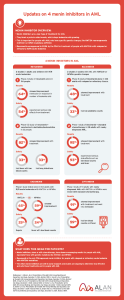
Menin inhibitors are a new type of treatment being studied for acute myeloid leukemia (AML). They work by blocking a protein called menin, which helps certain leukemia cells grow. This is particularly important for people with AML who have specific genetic changes, like KMT2A rearrangements (KMT2Ar) or NPM1 mutations (NPM1m). These genetic changes can make leukemia more aggressive and harder to treat.
By stopping menin from working, these therapies aim to stop leukemia cells from growing and help the body fight the disease more effectively. Menin inhibitors are showing promise in people who are newly diagnosed with AML, as well as in those whose disease has come back (relapsed) or hasn’t responded to other treatments (refractory).
In November 2024, the FDA approved revumenib, the first menin inhibitor, for people with KMT2Ar with relapsed or refractory acute leukemia. This approval is a major step forward, offering a new treatment option for people with AML.
Below are highlights from the ASH 2024 Annual Meeting, summarizing key findings about the safety and effectiveness of these new menin inhibitors.
Revumenib
Updated Results from the AUGMENT-101 Phase 2 Study in Relapsed/Refractory KMT2Ar Acute Leukemia(1)
What was the study about?
This phase 2 study looked at the effectiveness and safety of a menin inhibitor called revumenib. Revumenib was given on its own to adults and children with relapsed or refractory (R/R) KMT2Ar acute leukemia.
Study overview
Who participated? 116 people (average age 35.5 years; 24% were under 18). Most (82%) had AML and had already received an average of two previous treatments.
Key results
Effectiveness:
• 23% of patients had their leukemia go into remission, meaning there were little to no signs of cancer in their blood or bone marrow. This lasted for about 13 months on average
• 64% of patients showed improvements such as remission or reductions in leukemia cells
• 61% had no detectable cancer cells, based on very sensitive tests. This is called being “MRD negative”
Safety:
Serious side effects (grade 3 or higher) likely caused by the treatment were seen in 54% of patients. These are called treatment-related adverse events (TRAEs).
However, the most common serious side effects overall (whether or not they were caused by the treatment, called treatment-emergent adverse events or TEAEs) were:
• Fever with low white blood cell count (febrile neutropenia) – 39% of patients
• Low red blood cells (anemia) – 20%
• Changes in heart rhythm (QT prolongation) – 13%
• A potentially severe condition called differentiation syndrome occurred in 15% of patients, but was manageable with treatment. Differentiation syndrome has symptoms such as fever, weight gain and trouble breathing
Key takeaway
Revumenib, the first menin inhibitor to be approved in AML, continues to show promise for people with relapsed/refractory KMT2Ar leukemia. This updated analysis shows that revumenib can result in long-lasting improvement in people who have previously received two or more treatments. Side effects were common but generally manageable.
Combination Therapy with Revumenib, Venetoclax, and Decitabine/Cedazuridine in R/R AML(2)
What was the study about?
This phase 1/2 study looked at the safety and effectiveness of using revumenib (a menin inhibitor), together with venetoclax, and decitabine/cedazuridine. All treatments were taken as tablets, making this an all-oral combination. The combination was given to adults and children with relapsed or refractory AML who had specific genetic changes (KMT2Ar, NPM1m, or NUP98r mutations).
Study overview
Who participated? 33 people (average age 35; 15% were under 18). Patients had received an average of 3 previous treatments before. This included venetoclax in 58% of patients, while 36% had had a stem cell transplant before.
Key results
Effectiveness:
• 82% of patients showed improvements with treatment
• 48% went into remission, meaning little to no signs of cancer were detected
• 88% had no detectable cancer cells, based on very sensitive tests (MRD negative)
Safety:
The most common serious side effects (grade 3 or higher) were:
• Fever with low white blood cell count (febrile neutropenia) – 33% of patients
• Lung infections – 33%
• Less common side effects included heart rhythm changes (QT prolongation) in 9% and a potentially severe condition called differentiation syndrome occurred in 3%
• Four patients died during the study, but these deaths were thought to be due to disease progression and not caused by the treatment
Key takeaway
This all-oral combination therapy showed positive results. Many patients experienced a reduction in leukemia or had signs of disease disappear completely. While side effects, such as infections and low blood cell counts, were common, most could be managed with care.
The study is now enrolling newly-diagnosed people with AML who have KMT2Ar, NPM1m, or NUP98r mutations and are not eligible for intensive chemotherapy.
Bleximenib
Dose Optimization of Bleximenib in R/R Acute Leukemia(3)
What was this study about?
This phase 1b study tested how safe bleximenib, a menin inhibitor, is when used on its own, and aimed to find the best dose. It focused on people with relapsed or refractory (R/R) AML, who have specific genetic mutations (KMT2Ar or NPM1m).
Study overview
Who participated? 146 people (average age 60). Most people (90%) had AML and had already tried an average of two previous treatments.
Key results
Effectiveness:
• The best dose of bleximenib was identified as 100 mg twice a day
• At this dose, 48% of patients showed improvements with treatment
• 33% went into remission, meaning little to no signs of cancer were detected. This lasted about 6 months on average
Safety:
• The most common serious side effects (grade 3 or higher) were:
o Low platelet count (thrombocytopenia) – 32% of patients
o Low red blood cell count (anemia) – 27%
o Low white blood cell count (neutropenia) – 25%
• A potentially severe condition called differentiation syndrome occurred in 14% of patients. Most cases were mild, however 2 patients died from this condition
• Importantly, no heart rhythm changes (QT prolongation) were seen with bleximenib, a side effect that has been reported with other menin inhibitors
Key takeaway
Based on the results of this study, the best dose of bleximenib was found for treatment of people with relapsed/refractory AML. The next stage (phase 2) of this study is currently ongoing and will look at how effective and safe bleximenib is in a larger group of people with AML.
Bleximenib Combined with Intensive Chemotherapy in Newly Diagnosed AML(4)
What was this study about?
This phase 1 study looked at the safety of combining bleximenib with standard chemotherapy and investigated the best dose of bleximenib to use. This study focussed on people with newly diagnosed AML who have certain genetic mutations (KMT2Ar or NPM1m).
Study overview
Who participated? 28 people (average age 58) with newly diagnosed AML.
Key results
Effectiveness:
• 95% of patients showed improvements with combination therapy
• 86% went into remission, meaning little to no signs of cancer were detected
• Of the 9 patients who were tested for remaining cancer cells, 8 had no detectable cancer using very sensitive tests (MRD negativity)
• No patients died or relapsed during the study
Safety:
• Serious side effects (grade 3 or higher) occurred in 93% of patients. The most common were:
o Low platelet count (thrombocytopenia) – 68%
o Fever with low white blood cell count (febrile neutropenia) – 61%
o Low red blood cell count (anemia) – 54%
o Low white blood cell count (neutropenia) – 54%
• Importantly, there were no dose-limiting toxicities, which are serious side effects that can limit how much of the treatment can safely be given
• No heart rhythm issues (QT prolongation), and no differentiation syndrome (a potentially severe condition that can occur following cancer treatment) occurred during the study
Key takeaway
The combination of bleximenib with standard chemotherapy produced positive results, with most patients going into remission and many having no detectable cancer cells after treatment. Side effects like low blood counts were common but manageable. There were no life-threatening complications or relapses during the study. This promising approach is now being explored further to confirm its benefits in a larger group of patients.
Enzomenib
Phase 1 Results of Enzomenib for Relapsed/Refractory Acute Leukemia(5)
What was this study about?
This phase 1 study tested enzomenib, a menin inhibitor, for people with relapsed or refractory AML with specific genetic mutations (KMT2Ar or NPM1m). The study looked at the safety of enzomenib, how well patients could tolerate it, and the best dose to use.
Study overview
Who participated? 84 people (average age 62), most with AML (94%).
Key results
Effectiveness:
• Improvement following treatment was similar between people with the two mutations included in this study. 65% of people with KMT2Ar showed improvements with treatment compared with 59% of those with NPM1 mutations
• Complete remission (the disappearance of all signs of cancer) occurred in 30% of people with KMT2Ar and 47% of people with NPM1m
Safety:
• The most common serious side effects (grade 3 or higher) were:
o An extreme immune response to infection that can damage vital organs (sepsis) – 25%
o Fever with low white blood cell count (febrile neutropenia) – 24%
o Low platelet count (thrombocytopenia) – 21%
• A potentially severe condition called differentiation syndrome occurred in 11%
• Heart rhythm issues (QT prolongation) were seen in only 1% of patients
• No patients died due to treatment with enzomenib and the dose tested did not result in any patients having side effects so severe that they had to stop treatment
Key takeaway
Enzomenib shows potential as a treatment for relapsed/refractory AML, especially for those with KMT2Ar or NPM1 mutations. The number of patients improving with treatment was encouraging, and side effects were manageable. Importantly, no patient died from treatment with enzomenib. The study is still ongoing to find the best dose for future use.
Ziftomenib
Ziftomenib Combined with Intensive Chemotherapy in Newly Diagnosed AML(6)
What was this study about?
This phase 1 study tested ziftomenib, a menin inhibitor, combined with standard induction chemotherapy for people newly diagnosed with AML who have specific genetic mutations (KMT2Ar or NPM1m). The study looked at the safety and how well patients could tolerate this combination
Study overview
Who participated? 51 people (average age 58) with newly diagnosed AML.
Key results
Effectiveness:
• 91% of patients showed improvements with treatment
• 91% went into remission, meaning no visible signs of leukemia were found in their blood or bone marrow
• 76% reached MRD negativity, meaning even the most sensitive tests could not detect any remaining cancer cells
Safety:
• The most common serious side effects (grade 3 or higher) were:
o Fever with low white blood cell count (febrile neutropenia) – 59%
o Low platelet count (thrombocytopenia) – 41%
o Low red blood cell count (anemia) – 35%
o Low numbers of a type of white blood cell called neutrophils (neutropenia) – 35%
• No patients experienced serious heart rhythm changes (QT prolongation) or side effects so severe that they couldn’t receive the highest dose of treatment
• Only 1 patient developed a potentially severe condition called differentiation syndrome and one patient died on the study, but this was not thought to be caused by treatment
Key takeaway
Ziftomenib combined with chemotherapy shows high remission rates and potential as a treatment for people with newly diagnosed AML with KMT2Ar or NPM1 mutations. This treatment was generally well-tolerated, with no serious heart-related side effects and only one case of differentiation syndrome. Following these positive results, ziftomenib will now move onto further testing to find the best dose to use in this patient group.
What this means for patients
Menin inhibitors are a promising new type of treatment for people with AML, especially those with genetic mutations like KMT2Ar and NPM1m. These therapies, whether used alone or in combination with chemotherapy, have shown encouraging results, including high remission rates and the potential for lasting responses.
Currently, revumenib is the only FDA-approved menin inhibitor for people with relapsed or refractory acute leukemia with KMT2Ar mutations. The other menin inhibitors discussed in these studies are still in early stages of research and may take several years before they are widely available. Ongoing and future studies will help determine how effective and safe these treatments are for people with AML.
References
1. Aldoss I, et al. Presentation at the 66th ASH Annual Meeting and Exposition, San Diego, December 7, 2024. Abstract #211.
2. Issa GC, et al. Presentation at the 66th ASH Annual Meeting and Exposition, San Diego, December 7, 2024. Abstract #216.
3. Searle E, et al. Presentation at the 66th ASH Annual Meeting and Exposition, San Diego, December 7, 2024. Abstract #212.
4. Recher C, et al. Presentation at the 66th ASH Annual Meeting and Exposition, San Diego, December 7, 2024. Abstract #215.
5. Zeidner JF, et al. Presentation at the 66th ASH Annual Meeting and Exposition, San Diego, December 7, 2024. Abstract #213.
6. Zeidan AM, et al. Presentation at the 66th ASH Annual Meeting and Exposition, San Diego, December 7, 2024. Abstract #214.