
The Hidden Toll: Living with a Leukemia Diagnosis — as a Carer
A new international study puts numbers to what many families already know — that a leukaemia diagnosis doesn’t only belong to the patient. It reshapes the lives of everyone around them.
When the diagnosis arrives, it arrives for everyone
Behind every person living with leukaemia is usually someone else — a partner, a parent, a son or daughter — quietly absorbing the emotional weight, reorganising their life, and providing care that no job title fully describes. These are informal carers, and until recently, their wellbeing has largely been an afterthought in clinical care.
A new peer-reviewed study published in Frontiers in Hematology set out to change that. Researchers from the University of Hertfordshire, Picker Institute Europe, and the Acute Leukaemia Advocates Network (ALAN) conducted a global online survey to measure the quality of life (QoL) of adult informal carers supporting people living with leukaemia. The findings are striking — and carry direct implications for clinicians, policymakers, and the advocacy community.
38% of informal carer respondents scored above the critical threshold on the FROM-16 quality-of-life scale — indicating a “very large” impact on their personal and emotional wellbeing.
The FROM-16 (Family Reported Outcome Measure) is a validated 16-item questionnaire that assesses how a patient’s illness affects an informal carer’s life across emotional and personal/social domains. Scores range from 0 to 32. A score of 17 or above signals a “very large effect” on the carer’s quality of life.
The median score across all 511 respondents was 14 — squarely in the “moderate effect” band. But within that headline figure lie two very different stories: one for carers of people with acute leukaemia, and another for those supporting someone with a chronic form of the disease.
Acute vs. Chronic: Two distinct burdens
The study stratified respondents into two groups — those supporting someone with acute leukaemia (59% of respondents) and those supporting someone with chronic leukaemia (41%). The difference in their quality of life scores was stark.

The gap between a median score of 16 and a median score of 8 is not subtle. It reflects a difference in the fundamental nature of each caregiving experience. Acute leukaemia demands urgency — treatment is intensive, physical care is hands-on, and the crisis is immediate. Chronic leukaemia unfolds over years or decades, creating a sustained low-level strain that is no less real for being quieter.
Importantly, one in four carers in the chronic group still exceeded the critical threshold. The study is careful not to minimise this: chronic does not mean easy.
What makes the biggest difference
The research used robust statistical methods — non-parametric Kruskal–Wallis tests with conservative Bonferroni adjustment — to identify which factors were most strongly associated with poorer carer quality of life. Time emerged as the clearest signal.
Hours of care per week — chronic group. This was the single largest effect size in the entire study. Chronic carers providing 50+ hours per week reported a median FROM-16 score of 19, compared to just 3.5 for those providing under one hour.
Hours of care per week — acute group. Carers providing 50+ hours per week in the acute group had a median score of 20, versus 12 for those providing under an hour. A large and meaningful effect.
Giving medication — both groups. Medication management was consistently associated with higher FROM-16 scores, suggesting the clinical responsibility placed on carers takes a real psychological toll.
Personal care — chronic group. Carers who provided personal care for someone with chronic leukaemia had a median score of 17 — right at the critical threshold — versus 7 for those who did not.
“The nature of the caregiving task contributes to how the burden manifests.”
Beyond time and task, the study found important differences in who bears this burden. In the acute group, women reported meaningfully higher scores than men (median 17 vs. 14). Full-time carers unable to work due to caregiving responsibilities reported the highest median scores of any employment group — 21 out of 32. Adult children caring for a parent with acute leukaemia were also among the most burdened, with a median score of 20.
The chronic group: communication as a key variable
For carers of people with chronic leukaemia, clear communication from clinical teams was strongly associated with quality of life — more so than in the acute group. Carers who felt the diagnosis was not well explained to them scored a median of 22.5, compared to 7 for those who felt completely informed. The effect size (η² = 0.15) was one of the largest in the study.
Similarly, carers who always had to ask for test results to be explained reported a median score of 18 — compared to 6 for those who were proactively informed. Across a long caregiving relationship measured in years, being kept in the dark accumulates.
What this study tells us — and why it matters
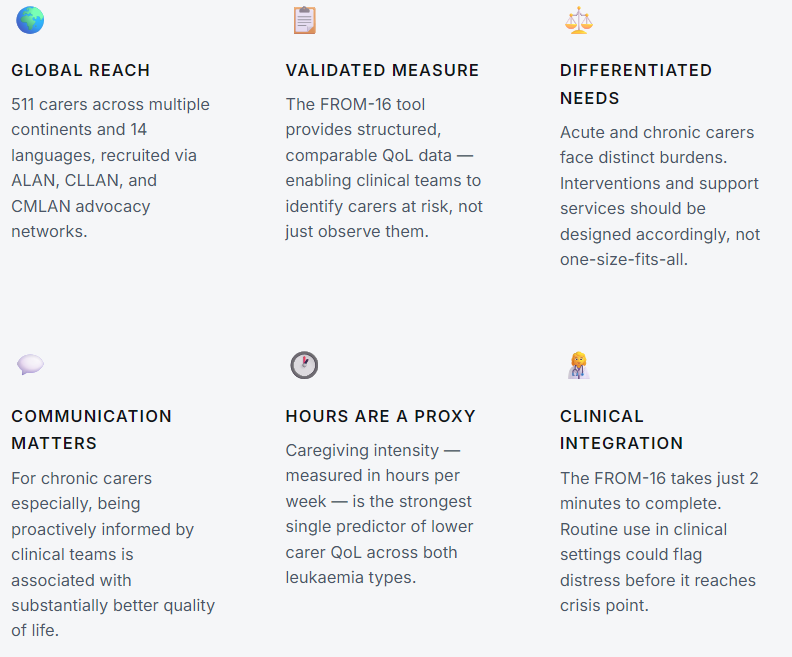
The FROM-16 takes just 2 minutes to complete. Routine use in clinical settings could flag distress before it reaches crisis point.
From data to action
The study’s authors are clear that acknowledging this burden is only the starting point. They call for tailored support strategies — respite services and financial guidance for those navigating acute leukaemia, and sustained emotional and logistical support for the quieter, longer road of chronic caregiving.
For clinicians, the FROM-16’s 2-minute completion time makes it a practical screening tool. Used routinely, it could support structured conversations about carer wellbeing — conversations that are still the exception rather than the rule in most oncology settings. It could also help measure the impact of new treatments not just on patients, but on the families around them.
For policymakers and advocacy groups, the findings add quantitative weight to a long-standing call: informal carers are not peripheral to leukaemia care. They are central to it. In the UK alone, unpaid carers of cancer patients of working age represent an estimated £8.58 billion in annual wage costs. Across the whole economy, unpaid care is worth an estimated £184.3 billion per year. The case for investing in carer support is not merely humanitarian — it is economic.
73% of informal carer respondents in this study were women. This gender dimension — rarely addressed directly in leukaemia care policy — should shape how support services are designed and targeted.
The authors are appropriately measured about the study’s limitations. The sample was drawn through advocacy networks and may skew toward more engaged or burdened carers. Cross-cultural differences in care norms, family roles, and QoL perceptions are real and not fully captured. The cross-sectional design means causality cannot be established.
But these caveats do not diminish what the study achieves: a consistent, validated, international picture of carer burden that the literature has so far lacked. It gives clinicians a tool, advocacy groups an argument, and policymakers a number — and behind every number in this dataset, there is a person whose life has changed irrevocably because someone they love has leukaemia.
That person deserves to be seen, counted, and supported.
Read the full study
Poots AJ, Nier S, Gunn S, Salek S. Associations with the quality of life of adult family members or partners (informal carers) of people with leukaemia: results from a cross-sectional online global survey. Front. Hematol. 2026;5:1813321. doi:10.3389/frhem.2026.1813321